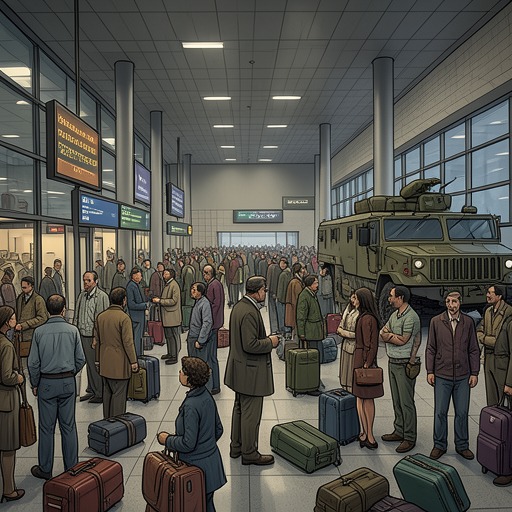
Luanda airport
Another Day of LifeLuanda airport is a changing threshold between a city emptied by flight and a war sustained by fragile air links. Around it, Portuguese refugees form a makeshift settlement while awaiting evacuation; later, it serves as a vital supply base for the MPLA and receives soldiers from Cuba, who are sent to the front the next day.
Refugees and the Makeshift Settlement
As Portuguese residents arrived in Luanda from across Angola, caravans of cars brought people and baggage from distant parts of the country. Refugees travelled in large groups, which they regarded as safer. They first filled the city’s hotels; when there was no room left, many drove directly to the airport. A settlement without streets or houses grew around it, with people living outdoors in persistent rain. The nearby African quarter offered better conditions than the airport camp, despite its own severe deprivation.
The airport became the setting for an improvised and contested system of evacuation. People waited for weeks without knowing when or where they would fly. Attempts to establish priority—first for pregnant women, then for women with infants or children—did not satisfy the crowd. At times, people who had secured places were forced to leave the aircraft so women with children could board. The army intervened, and the departing women went aboard after blocking the plane’s movement on the tarmac. No rule settled the competition for seats, and each departure left the question of who would be taken next unresolved.
The scale of the task dwarfed the improvised arrangements: an air bridge was needed to carry half a million refugees to the other side of the world. French, Portuguese, Russian, and Italian planes flew in and out, often several a day. Their pilots had arrived from Europe only hours earlier, a reminder of how distant Europe seemed to people waiting at the airport. As the flights continued, the open-air settlement gradually vanished.
A Link in Luanda’s Supply Chain
The airport also connected a city with failing services and a fragmented transport network to the fronts beyond it. Ruiz, a Portuguese pilot, flew the MPLA’s only plane in Luanda: an old, patched two-engine DC-3 built in 1943. He used it to bring ammunition from Brazzaville, deliver cartridges and flour to besieged towns, and carry seriously wounded people back to Luanda. The fate of garrisons and the city’s ability to hold out could depend on whether he arrived.
There were no air controllers, and Ruiz sometimes did not know who controlled the airport where he was meant to land. He would first fly over an airfield to assess the situation: if he recognized people there, he could descend; if the defenders fired on the plane, he had to turn back and report the loss of the route. He made several trips a day and returned at midnight. In the early morning, the airport was where he could be found inspecting the plane’s motors. With no spare parts or mechanics, an engine failure could ground the aircraft and interrupt the supply journeys on which Luanda depended.
The Airport After the Refugee Camp
By the beginning of November, the airport’s visible function had changed. Foreign correspondents had flown in from Lisbon for the expected proclamation of Angolan independence by Agostinho Neto. They were lodged in the same hotel as the narrator, while their host, Oscar, struggled to find food for them. Their presence made the airport part of the preparations for an international audience, even as the city around them remained under pressure.
On the evening of November 5, the airport terminal was empty, though still filthy from the half million refugees who had camped there. In heavy rain, the narrator and Gilberto Santos e Castro watched from the second floor as a Cubana Airlines Britannia landed. Three more planes followed. Soldiers from Cuba disembarked with packs and weapons, formed two lines, and walked to waiting trucks. The next day, they went to the front.
A Changing Threshold
The airport’s successive crowds mark distinct phases in the city’s crisis. First, it holds people seeking a way out, while the air bridge offers only an uncertain and fiercely contested route. Later, it serves as a working link for the MPLA’s supply flights, where a single vulnerable aircraft connects Luanda to isolated garrisons. Then, after the refugee settlement has disappeared, soldiers arrive by air and travel onward to fight. The airport does not stand outside the war: it is where flight, supply, and military arrival meet.